
 Money making
Gold
OSRS GotR vs Blood Runes: XP, GP & Buying Gold
Guardians of the Rift and blood rune crafting both turn Runecraft into a real moneymaker, but the right choice depends on your level, attention span, and account goals. Compare realistic GP/hour, uniques, and when buying gold is cheaper.
Game screenshots and facts are cited from the Old School RuneScape Wiki (strategy, equipment, drops, and related pages). Writing is original editorial, not a copy of the wiki article.

Runecraft has never been the first skill players pick when they want fast GP, but Guardians of the Rift and blood rune crafting have turned it into a legitimate moneymaker. The choice between the two comes down to whether you want passive uniques, low-intensity grinding, or the highest raw profit per hour once your level and gear are ready. This guide breaks down realistic GP/hour after supplies, attention levels, loot variance, and the point where buying OSRS gold outright is the cheaper path.

Both methods share the same core skill, but they play very differently. Guardians of the Rift is a non-combat minigame with a repeating loop and a rewards shop that spits out account-changing untradeables. Blood rune crafting is a more traditional Runecraft grind—either running through the Abyss with high risk and high reward, or mining dense essence in Arceuus for a semi-afk, steady profit. Use this guide to pick the one that matches your account stage and patience.

Who Is This For? Requirements and Baseline
Guardians of the Rift is available after the Temple of the Eye quest and requires only 27 Runecraft, which you will have by the end of that quest. Blood runes, on the other hand, demand level 77 Runecraft before you can craft them at either the True Blood Altar or the Kourend Blood Altar. This gap is the first and most obvious filter: GotR is accessible to early accounts, while blood runes are a mid-to-late game money maker.
- Guardians of the Rift: Temple of the Eye quest, 27 Runecraft (from quest), any pickaxe, a chisel if you plan to craft guardians.
- Blood runes (Kourend Altar, Arceuus): 77 Runecraft, 38 Mining and 38 Crafting to mine and chip dense essence blocks, 62+ Agility recommended for abyss shortcuts.
- Blood runes (True Blood Altar): 77 Runecraft plus progress in the Myreque questline; verify the exact quest on the wiki before starting.
- Strongly recommended for both: full Raiments of the Eye for +60% runes, an abyssal lantern (blisterwood logs for +20% blood runes), and all essence pouches.
If you are still working through early Runecraft levels, jumping straight to blood runes is not an option. GotR is the natural bridge: it gives useful uniques you will want for blood rune crafting anyway, and the XP per game scales with your Runecraft level. See our OSRS Maxing Guide for how Runecraft fits into late-game account planning.
Guardians of the Rift: The Non-Combat Moneymaker
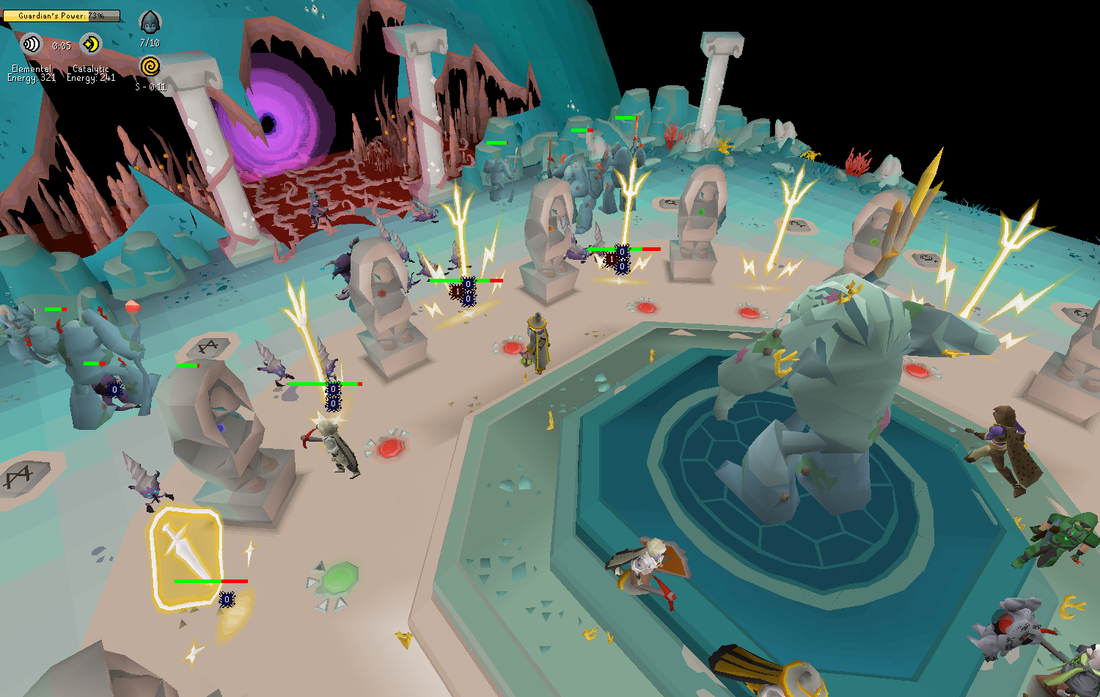
GotR takes place inside the Temple of the Eye. The loop is simple: mine guardian essence, charge cells at workbenches, build barriers and guardians, and keep the Great Guardian alive while it seals the abyssal rift. You do not need combat stats, and death is not a risk, which makes it ideal for players who want money while watching a second screen.


The battle has three phases. During the first two minutes you prepare by mining guardian essence and using uncharged cells to build barriers and guardians. After that, abyssal creatures spawn and attack the Great Guardian. When the guardian reaches 60% charge, all active barriers take 50 damage and more monsters appear. At 100% charge the rift closes and you win. Fail the energy check and the game ends with no reward, so you cannot fully afk this minigame.
Each game rewards Runecraft experience equal to 45 times your Runecraft level, as long as you earn at least 300 total energy. You also receive one elemental or catalytic point for every 100 energy of that type, with a chance to round up. A maximum of 1,200 total energy can be earned per game, or 1,320 with the abyssal lantern burning yew logs. Points are spent at the Rewards Guardian outside the rift.
Unique Rewards That Change the Account
- Abyssal pearls – currency for the Temple Supplies shop, including Raiments of the Eye pieces.
- Raiments of the Eye – each piece gives 10% extra runes, full set gives 60% more runes. This is the single biggest profit multiplier for all runecrafting.
- Abyssal needle – combines all essence pouches into one colossal pouch, saving inventory and time.
- Abyssal lantern – effects change with log type; blisterwood logs make blood rune crafting 20% more productive.
- Intricate pouch – can give a tarnished locket, lost bag, dragon items, or a hard clue.
- Abyssal protector pet – rare cosmetic drop.
The wiki lists Guardians of the Rift at around 1,092,676 GP per hour with 27 Runecraft minimum and 77+ recommended. That figure includes selling the runes and talismans from rewards, but it does not account for the time you spend buying or collecting supplies—though GotR itself is nearly supply-free. The real value is often in the untradeables: getting the full Raiments set and needle before you start blood rune crafting is a wise investment.
Blood Rune Crafting: The 77 RC Payoff
Once you reach 77 Runecraft, blood runes become a consistent, high-volume money maker. There are two main routes: the True Blood Altar accessed through the Abyss or a nearby shortcut, and the Kourend Blood Altar in Arceuus where you mine dense essence blocks and chip them into dark essence. Both benefit enormously from Raiments of the Eye, an abyssal lantern with blisterwood logs, and blood essence.


A blood essence gives a 50% chance per essence to craft an extra blood rune and is consumed after 1,000 extra runes. It is not always worth using; you need to check whether the cost of the essence is lower than the value of the expected extra runes at current prices.
Tip: Only activate blood essence if the extra 500–1,000 blood runes you expect will sell for more than the essence cost. With Raiments and blisterwood lantern already active, the break-even price shifts; always do the math before bulk-buying essences.


The wiki’s money making guides for blood runes show a wide spread depending on method and account unlocks:
- Crafting blood runes through the Abyss: ~2,634,419 GP/hour with high attention, 77 RC, 62+ Agility recommended, and 70+ Mining optional for rock shortcuts.
- Crafting blood runes (True Blood Altar, max setup): ~3,340,099 GP/hour with full Raiments, blood essence, blisterwood lantern, and high Agility for the fastest shortcut.
- Crafting blood runes at Arceuus (minimal requirements): ~679,132 GP/hour—low attention but much lower profit.
- Crafting blood runes at Arceuus (no diary): ~1,068,388 GP/hour with Raiments and blood essence, still relaxed.
- Crafting blood runes at Arceuus (max): ~1,117,045 GP/hour with all boosts and diary/quest unlocks.
The Abyss method is the best raw money but forces you through the Wilderness and demands constant clicking. Arceuus is the opposite: you bank less, mine dense essence in a loop, and can watch videos. The True Blood Altar variant is a compromise if you have the questline done.
XP vs GP: A Side-by-Side Comparison
Both options train Runecraft, but the feel is completely different. GotR gives a guaranteed chunk of XP per completed game and has a built-in fail state that keeps you engaged. Blood runes give standard altar XP per essence, which can be very fast if you have all pouches, energy, and teleports sorted, but it is repetitive and can burn you out.
| Method | Requirements | Attention Level | GP/hour (wiki) | XP Focus | Notes |
|---|---|---|---|---|---|
| Guardians of the Rift | 27 RC, Temple of the Eye, pickaxe | Medium—react to phases | ~1,092,676 | 45 × RC level per game | Best source of Raiments, needle, lantern uniques |
| Blood runes via Abyss | 77 RC, 62+ Agility, optional 70+ Mining | High—wilderness, quick banking | ~2,634,419 | Standard altar XP per essence | Highest profit of the two, but high risk and click intensity |
| Blood runes at Arceuus (no diary) | 77 RC, 38 Mining, 38 Crafting | Low—semi-afk loop | ~1,068,388 | Standard altar XP per essence | Very stable, low input, can be done on mobile |
| Blood runes at Arceuus (max) | 77 RC, 38 Mining/Crafting, diary/quests, all boosts | Low—semi-afk loop | ~1,117,045 | Standard altar XP per essence | Slightly better than no diary, but not a huge jump |
Notice the trade: GotR sacrifices raw GP for unique rewards and variety. Blood runes reward a fully optimised account with two to three times the profit. If you are planning to max Runecraft eventually, consider doing GotR first for Raiments and needle, then switching to blood runes with those boosts active.
Supply Costs, Loot Variance, and Attention Levels
GotR has almost no supply cost: you mine guardian essence inside the minigame, and the only external items are a pickaxe and optional chisel. Blood rune crafting, however, requires an essence source. Pure essence from the Grand Exchange is a direct cost, while mining dense essence in Arceuus takes time but removes that cost. Do not forget stamina potions, teleport jewellery charges, and pouch repair costs.
Loot variance matters more for GotR because the rewards are random. You might go hours without a valuable unique, then pull an abyssal needle or a large rune stack that spikes your hourly profit. Blood runes are the opposite: each inventory is nearly identical, so your profit is predictable but sensitive to the price of blood runes themselves. Blood essence adds a 50% roll on every essence, smoothing out the randomness but adding a variable supply cost.
Common Mistakes That Drain Your Profit
- Skipping Raiments of the Eye before doing blood runes. Without the full set, you craft 60% fewer runes per essence. That turns a 1,000k/hr method into roughly 625k/hr before any other boosts.
- Using blood essence blindly. If blood essence costs more than the expected extra runes, you are paying to lose money. Check the margin before buying in bulk.
- Forgetting the abyssal lantern log type. Blisterwood logs give +20% blood runes, which is massive. Using no lantern or the wrong logs leaves a lot of profit on the table.
- Ignoring the GotR phases. If barriers break or the Great Guardian’s energy hits 0%, the game fails and you lose most of the reward. Pay at least medium attention.
- Running the Abyss without a plan. High Agility and Mining shortcuts, emergency teleports, and knowing the path save minutes per hour. Every mistake costs GP.
- Not repairing essence pouches. Degraded pouches hold less essence, lowering both XP and profit. Use the NPC contact spell or the abyssal needle with redwood lantern to avoid this.
When Buying Gold Beats Grinding It Yourself
Grinding from 27 to 77 Runecraft at GotR, then setting up blood rune infrastructure, takes dozens of hours. If your goal is a specific gear upgrade or a big stack of supplies for bossing, those hours have an opportunity cost. At the wiki’s best blood rune rates of around 3.3m/hour, you would need roughly 30 hours of perfect play to earn 100m. If your real-life time is limited or you simply hate the skill, buying OSRS gold may be the cheaper path when measured in hours saved.
That does not mean you should skip Runecraft entirely—the skill has account-wide benefits and unlocks diary tasks—but for pure cash, there are faster in-game options, and using a marketplace to skip the middle grind is an honest choice. If you decide to buy, do it once for a specific goal rather than as a recurring habit, and always keep enough in-game cash for supplies and flips.
Practical Next Step: Build a Runecraft Money Routine
Here is a step-by-step plan that combines both methods efficiently, assuming a fresh or mid-level account:
- Complete Rune Mysteries, Enter the Abyss, and Temple of the Eye. Unlock Guardians of the Rift and grab your medium pouch.
- Do GotR from 27 to 77 Runecraft. Aim to collect enough abyssal pearls for the full Raiments of the Eye set, and hope for an abyssal needle and a good lantern roll.
- At 77, decide your style: if you want high profit and can handle attention, set up Abyss blood runes with all pouches, Raiments, blisterwood lantern, blood essence, and stamina potions. If you prefer low effort, do Arceuus dense essence runs with the same outfit.
- Reinvest the first few hours of profit into supplies: more blood essence if profitable, better teleports, or a ring of endurance to reduce run energy drain.
- For long-term account planning, see our OSRS Maxing Guide to place Runecraft alongside Slayer and Agility without burning out.
Runecraft money making is not about one method being strictly better; it is about matching the activity to your account and attention span. GotR is the teacher that pays you, blood runes are the graduate job. Use both in order, and you will have the cash stack to prove it.
Sources
Frequently asked questions
Is Guardians of the Rift good money in OSRS?
Yes, GotR can earn around 1.09 million GP per hour according to the wiki, and it also rewards untradeable uniques like Raiments of the Eye and the abyssal needle that significantly boost future Runecraft profit. It is best after level 77 when the rune rewards improve.
How much GP per hour is blood rune crafting?
Blood rune crafting ranges from about 679k GP/hour at Arceuus with minimal requirements to over 3.3m GP/hour with a maxed setup through the True Blood Altar. Using Raiments of the Eye, blood essence, and a blisterwood abyssal lantern is essential for top rates.
What level do you need for blood runes in OSRS?
You need level 77 Runecraft to craft blood runes at either the True Blood Altar or the Kourend Blood Altar. The Kourend method also requires 38 Mining and 38 Crafting for dense essence, while the True Blood Altar has additional quest requirements to check.
Is GotR better XP than blood runes?
It depends on your level and attention. GotR gives 45 times your Runecraft level per game, which is competitive and low-risk. Blood altar methods can give higher XP per hour with perfect clicks and all pouches, but GotR is more relaxed and gives essential uniques for later profit.
What are the unique rewards from GotR?
Unique rewards include Abyssal pearls for Raiments of the Eye, the abyssal needle for the colossal pouch, the abyssal lantern with various log effects, intricate pouches with loot, and the rare Abyssal protector pet. These uniques are untradeable and improve your Runecraft account.
Do you need Raiments of the Eye for blood rune money?
You do not need it, but the full set gives 60% more runes per essence, which is the single largest profit boost for blood rune crafting. Skipping Raiments reduces your GP/hour by roughly 37.5%, so it is strongly recommended to grind GotR first.
Should I buy OSRS gold instead of grinding runecraft?
If you value your time and the cost of gold is less than what you would earn per hour in-game, buying may be cheaper. However, Runecraft has account-wide benefits and diary tasks, so consider doing the skill for progression and buying gold only for a specific gear goal.
Marketplace
Get live rates, instant quotes, and hand-traded delivery on Trillionaire Services.
Related listings
 Money making
Hunter Rumours GP: Varlamore Money Making Guide
Hunter Rumours turn the Hunter skill into a Slayer-style task system with loot sacks and rare uniques. This guide compares attention level, GP variance, and when buying gold is the cheaper path.
 Money making
How to Buy OSRS Gold Safely in 2026
A practical checklist for buying OSRS gold without bans, scams, or surprise fees - rates, delivery methods, and what trustworthy sellers do differently.
Money makingOSRS Gold Prices Explained: What Moves the Rate
Bond prices, demand spikes, stock levels, and payment fees - why OSRS gold rates change and how to read a marketplace quote.