
 Leveling
Guides
OSRS Drift Net Fishing vs Separate Hunter & Fishing: XP Guide
Drift net fishing pairs Hunter and Fishing XP in one Fossil Island loop, but is it better than training each skill separately? We compare attention, cost, and 99 time, and when buying gold is the honest shortcut.
Game screenshots and facts are cited from the Old School RuneScape Wiki (strategy, equipment, drops, and related pages). Writing is original editorial, not a copy of the wiki article.
Most OSRS skilling methods force a choice: do you want Hunter experience or Fishing experience? Drift net fishing breaks that pattern by rewarding both skills for every fish shoal you chase into a net. It is not the fastest Hunter method, and it is not the fastest Fishing method, but it is the most efficient combined loop for accounts that still need both 99s. Before you queue up another birdhouse run or settle into monkfish, it is worth understanding exactly where drift net fishing wins and where splitting the skills makes more sense.

Why Drift Net Fishing Reshapes Two Skills at Once
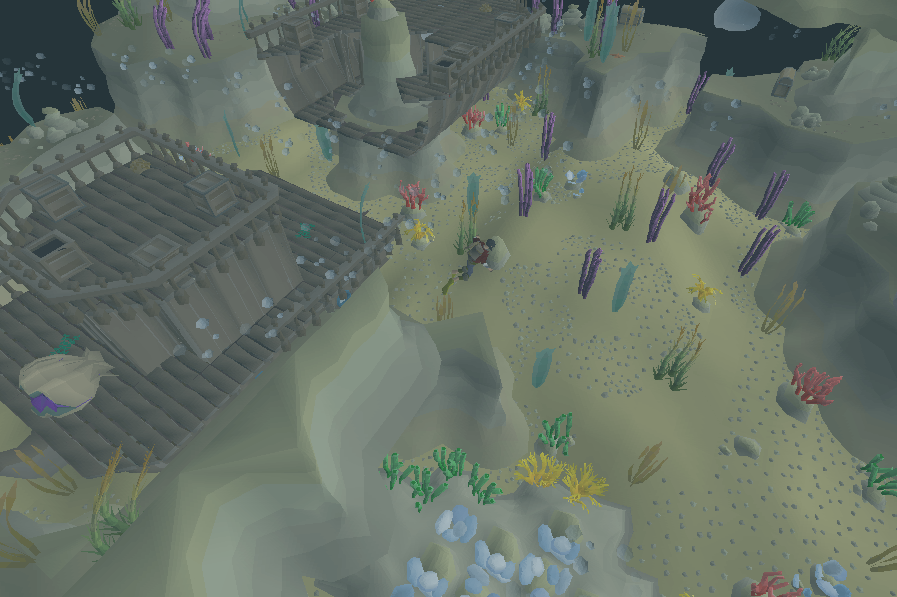
Drift net fishing sits inside Fossil Island's underwater area, gated behind Bone Voyage and level 44 Hunter with 47 Fishing. The loop itself is simple: set up a drift net on an anchor, click a nearby fish shoal to chase it into the net, and repeat until the net has caught ten shoals. Harvesting the full net destroys it, returns Hunter and Fishing XP scaled by your levels, and gives fish loot. What makes it special is the combined XP curve. At level 70 in both skills, one hour of focused drift netting can deliver around 116,725 Hunter XP and 88,550 Fishing XP — over 205,000 combined skill XP per hour. Trained separately, reaching that same combined rate would require you to alternate between a high-intensity fishing method and a separate Hunter grind. Drift netting compresses both into one set of clicks, making it a time-efficient option for mid-game accounts that still need both skills.
Requirements and Recommended Gear
You cannot boost into drift net fishing. Both the Hunter and Fishing requirements are hard checks, and access to Fossil Island is mandatory. On top of that, the underwater area demands specific equipment or you will be wasting time refilling oxygen. Here is the full checklist before your first hour.
- Bone Voyage completed for Fossil Island access
- 44 Hunter and 47 Fishing — non-boostable
- At least one drift net per hour of training; expect 80–110 nets used per hour depending on efficiency
- Diving apparatus and fishbowl helmet or a medallion of the deep to prevent oxygen depletion
- 200 numulites per day or 20,000 numulites for permanent underwater access
- Strongly recommended: flippers, merfolk trident / trident of the seas / trident of the swamp / dragon harpoon, partial graceful outfit, and stamina potions
Annette, located inside the drift net area, can store up to 2,000 noted drift nets for you. That means you can buy in bulk on the Grand Exchange, bring noted nets, and never worry about running out mid-session. Flippers are especially important because they let you sprint underwater, directly increasing the number of fish shoals you can chase per hour. A trident or dragon harpoon raises your chance of successfully herding a shoal, which translates into fewer failed clicks and more XP.
How the Drift Net Loop Actually Works
Once you have paid the numulite fee, enter the underwater area in the northern part of Fossil Island by speaking to Ceto. The activity zone has several drift net anchors. Your job is to set a net on an anchor and then click fish shoals to drive them toward your net. A net becomes full after 10 fish shoals are caught. At that point you harvest it, which destroys the net and triggers the XP and loot roll.
The attention requirement is moderate by OSRS skilling standards. It is far more click-intensive than AFK fishing options like monkfish or minnows, but much less punishing than 2-tick harpooning. You need to constantly reposition, chase shoals, and reset nets. Prioritising shoals nearest to your nets is the single biggest mechanical tip for better rates. With good practice, players can catch around 1,150–1,250 fish shoals per hour, with the lower end assuming some missed clicks or slower movement.
When you harvest, you can choose to discard the fish, take them, or pay 5 numulites per full net to send everything straight to the bank. Banking reduces XP rates slightly because of the extra interaction, but it recovers some of the cost of drift nets through fish loot and occasional seaweed spores.
Experience Rates, Costs, and Why Levels 70/70 Matter
Drift net XP per shoal scales with your Hunter and Fishing levels, capping at level 70 in both skills. Below that, every level you gain increases the XP per catch. This is why the method feels mediocre at 44 Hunter and 47 Fishing, then becomes much stronger as you approach the 70/70 breakpoint. The following table uses the commonly cited baseline of 115 drift nets per hour, equal to 1,150 shoals caught.
| Hunter / Fishing Level | Hunter XP/hr | Fishing XP/hr | Combined XP/hr |
|---|---|---|---|
| 44 / 47 | 60,145 | 53,130 | 113,275 |
| 50 / 50 | 71,875 | 57,500 | 129,375 |
| 55 / 55 | 82,225 | 64,745 | 146,970 |
| 60 / 60 | 93,150 | 72,450 | 165,600 |
| 65 / 65 | 104,650 | 80,270 | 184,920 |
| 70 / 70 | 116,725 | 88,550 | 205,275 |
At current Grand Exchange prices, buying 115 drift nets costs around 191,935 coins per hour. That puts combined XP at roughly −0.94 gp per XP at 70/70, which is cheap compared to many buyable skills. The fish loot can offset that cost, especially at higher Fishing levels when raw sharks and other valuable fish enter the pool. Seaweed spores also spawn on the floor during the activity and can be picked up for extra profit.
Drift net XP is not boosted by visible level boosts. The non-boostable requirement means you must have the base levels, but trident/harpoon success chance scales with the weapon, not a boosted level.
Drift Net vs Training Hunter and Fishing Separately
The real question for any account is opportunity cost. If you only need Hunter XP, birdhouse trapping is far more passive and black chinchompas are far faster Hunter XP per hour. If you only need Fishing XP, 2-tick harpooning swordfish and tuna is significantly faster Fishing XP, and AFK methods like monkfish or anglerfish require almost no attention. Drift net fishing only wins when both skills are still below your target level and you value combined XP over raw single-skill speed.
For Hunter alone, the standard progression is Natural History Quiz to level 9, then birdhouse runs from level 9 to 44 or even 80. Birdhouses offer recurring low-effort XP on a 50-minute cycle, and many players keep doing them all the way to 99 alongside other training. Once you hit 44 Hunter, drift net fishing becomes available, but if you already have 99 Fishing, you are better off continuing birdhouses or switching to active Hunter methods like falconry from 43–49, razor-backed kebbits from 49–73, or black chinchompas from 73–99. Hunters' Rumours is also a strong option for those after variety.


For Fishing alone, the fastest route after early questing uses fly fishing to 58, barbarian fishing to 71, and then 2-tick harpooning swordfish and tuna to 99. That path also gives small Strength and Agility XP from barbarian fishing, but the attention requirement is extreme. More relaxed accounts often switch to monkfish at 62, minnows at 82, or anglerfish at 82 for AFK-style training. Tick manipulation methods like cut-eat fishing can further increase XP at the cost of very high APM.


If you still need both Hunter and Fishing XP, drift netting quietly outperforms alternating between a Fishing session and a Hunter session. It saves you the overhead of switching gear, running to different locations, and mentally resetting between methods. The combined rate of over 200k XP/hr is not just convenient; it is often higher than the sum of two low-intensity methods you would otherwise do.


Supplies, Banking, and Cost Management
Drift nets are the primary consumable cost. At roughly 1,669 coins each on the Grand Exchange, an hour of training can cost 160k–190k coins. That is a real expense, but it is recoverable through fish loot and seaweed spores. Players who choose to bank their fish for 5 numulites per full net will earn back a meaningful portion of the net cost, especially once they can catch lobsters, swordfish, and sharks. The trade-off is slightly lower XP per hour due to the extra banking interaction.
Numulites are the second cost. Daily access costs 200 numulites, but serious trainers should pay 20,000 numulites for permanent access. Numulites can be obtained from various Fossil Island activities, so you may already have a stockpile. If not, they can be purchased on the Grand Exchange or gathered passively.
Exact Grand Exchange prices for drift nets, numulites, and fish change constantly. Always verify current prices on the OSRS Wiki or your preferred price tracker before committing to a large supply purchase.
For players who would rather spend their time chasing fish shoals than grinding out coins for supplies, buying OSRS gold is an honest shortcut. Funding a few thousand drift nets and permanent underwater access can be done in minutes through a gold marketplace, leaving your playtime for the actual training.
Common Mistakes and How to Avoid Them
- Skipping flippers or diving apparatus — you will spend far too much time surfacing for air or walking instead of sprinting.
- Not paying for permanent access — if you plan more than a few hours at drift net fishing, the 20k numulite fee saves money over daily payments.
- Chasing far-away fish shoals — the best XP comes from shoals close to your nets; wasting movement on distant shoals tanks your hourly rates.
- Using level boosts to meet requirements — Hunter and Fishing boosts do not work for the 44/47 requirement; you need base levels.
- Expecting a Heron pet — the Heron is not obtainable from drift net fishing, so pet hunters should spend time on traditional fishing methods.
- Forgetting stamina potions — run energy depletes quickly underwater, and stamina potions are essential for maintaining a high shoal-per-hour count.
When Buying Gold or a Service Is the Honest Shortcut
Drift net fishing is efficient but not free. The upfront requirements — Bone Voyage, diving gear, flippers, a trident or dragon harpoon, and a stack of drift nets — can feel like a gear wall for a mid-level account. If your bank value is low, the fastest honest shortcut is to buy OSRS gold to fund the supplies. This is not against the game rules when purchased from a third-party marketplace; it simply trades real-world money for in-game convenience. You still do the training yourself, but you skip hours of moneymaking that would otherwise delay your levels.
For players who value their time more than their gold, a boosting service can be an even larger shortcut. Handing your account to a skilled player to run drift nets or complete the required quests is a legitimate service many marketplaces offer, though you should always verify the provider's reputation. The same logic applies to pure Fishing or Hunter training: if you only need one skill, a powerleveling service for that skill may be cheaper and faster than buying drift nets and doing the combined method.
Compare the cost of a service to the time it would take you to reach your goal. An hour of drift netting at 70/70 gives 205k combined XP. Reaching 99 in both skills from 70/70 requires roughly 12.5 million combined XP in each skill, or about 25 million total XP. At 205k XP/hr, that is around 122 hours of drift netting. A service can often cut that to a fraction of the real-time wait.
Final Verdict: When to Drift Net, When to Split
Drift net fishing is the best method in OSRS for accounts that need Hunter and Fishing levels in roughly equal measure and want a single, sustainable grind. It offers great combined XP, moderate attention, and a built-in loot offset. The method shines from level 44 Hunter / 47 Fishing up to level 70/70, after which the XP per shoal stops scaling but remains strong.
You should split the skills instead when only one of them matters. If you already have 99 Fishing, drift netting becomes an inefficient Hunter method; birdhouses and active Hunter training will get you to 99 Hunter faster. If you already have 99 Hunter, the Fishing half of drift netting is not enough to justify the attention when AFK methods like minnows or monkfish exist, and 2-tick harpooning is the better choice for maximum Fishing XP per hour.
Finally, consider the time-to-goal honestly. If you enjoy the interactive loop of chasing shoals and managing nets, drift netting to 99 in both skills is a perfectly viable path. If you would rather do birdhouse runs between AFK fishing sessions, the separate route is slower in combined XP but far less demanding. The best method is the one you will actually stick with — and if gold or a service removes the initial supply grind, that is an honest shortcut worth weighing. View live gold rates to see what an hour of drift net supplies costs right now.
Sources
Frequently asked questions
What levels do I need for drift net fishing in OSRS?
You need 44 Hunter and 47 Fishing, both non-boostable, plus completion of Bone Voyage to access Fossil Island. You also need a diving apparatus and fishbowl helmet or medallion of the deep, and you must pay numulites for underwater access.
Is drift net fishing better than training Hunter and Fishing separately?
Yes, if you still need both skills. Drift net fishing gives over 200,000 combined XP per hour at level 70/70, which is efficient compared to alternating between separate methods. If you only need one skill, dedicated Hunter or Fishing training is faster for that skill.
How much XP per hour is drift net fishing?
At level 70 Hunter and 70 Fishing, you can earn up to 116,725 Hunter XP and 88,550 Fishing XP per hour, around 205k combined. Rates scale up to level 70 in both skills. With good practice, higher shoal counts can push rates slightly above these figures.
Does drift net fishing cost money?
Yes, drift nets cost about 1,669 coins each on the Grand Exchange, so 115 nets per hour cost around 192k coins. You can offset this by banking fish for 5 numulites per full net, collecting seaweed spores, and selling the fish loot.
Can I get the Heron pet from drift net fishing?
No, the Heron pet is not obtainable from drift net fishing. If you are pet hunting, you need to use traditional fishing methods. Drift net fishing still gives regular fish, numulites, fossils, and medium clue bottles as rewards.
What is the best AFK alternative to drift net fishing?
For Fishing, monkfish at 62, minnows at 82, or anglerfish at 82 offer low-attention AFK training. For Hunter, birdhouse runs on Fossil Island provide passive XP every 50 minutes. These methods are more AFK but give only one skill's XP.
Do I need a dragon harpoon for drift net fishing?
A dragon harpoon is recommended but not required. Any merfolk trident, trident of the seas, trident of the swamp, or dragon harpoon increases your chance of successfully chasing fish shoals into the net, improving hourly XP rates.
Marketplace
Get live rates, instant quotes, and hand-traded delivery on Trillionaire Services.
Related listings
 Leveling
Varlamore Wealthy Citizens vs Ardougne Knights: Thieving 50–99 on Mains and Irons
Compare Varlamore wealthy citizens and Ardougne knights for Thieving 50–99. See XP rates, profit, fail rates, diary boosts, and when buying gold or a boost is the smart shortcut.
 Leveling
OSRS Defence 70-99: Void vs Obsidian NMZ Guide
Compare Pest Control Void armour progression with AFK obsidian training at Nightmare Zone for 70-99 Defence. XP rates, gear unlocks, attention required, and time-to-goal.
 Leveling
OSRS Magic 77-99: Tan Leather vs Superglass Make – Profit per Cast & Market Margins
Compare Tan Leather on dragonhide vs Superglass Make for Magic training 77–99, including XP per cast, profit formulas, market margins, and when buying gold is the honest shortcut.